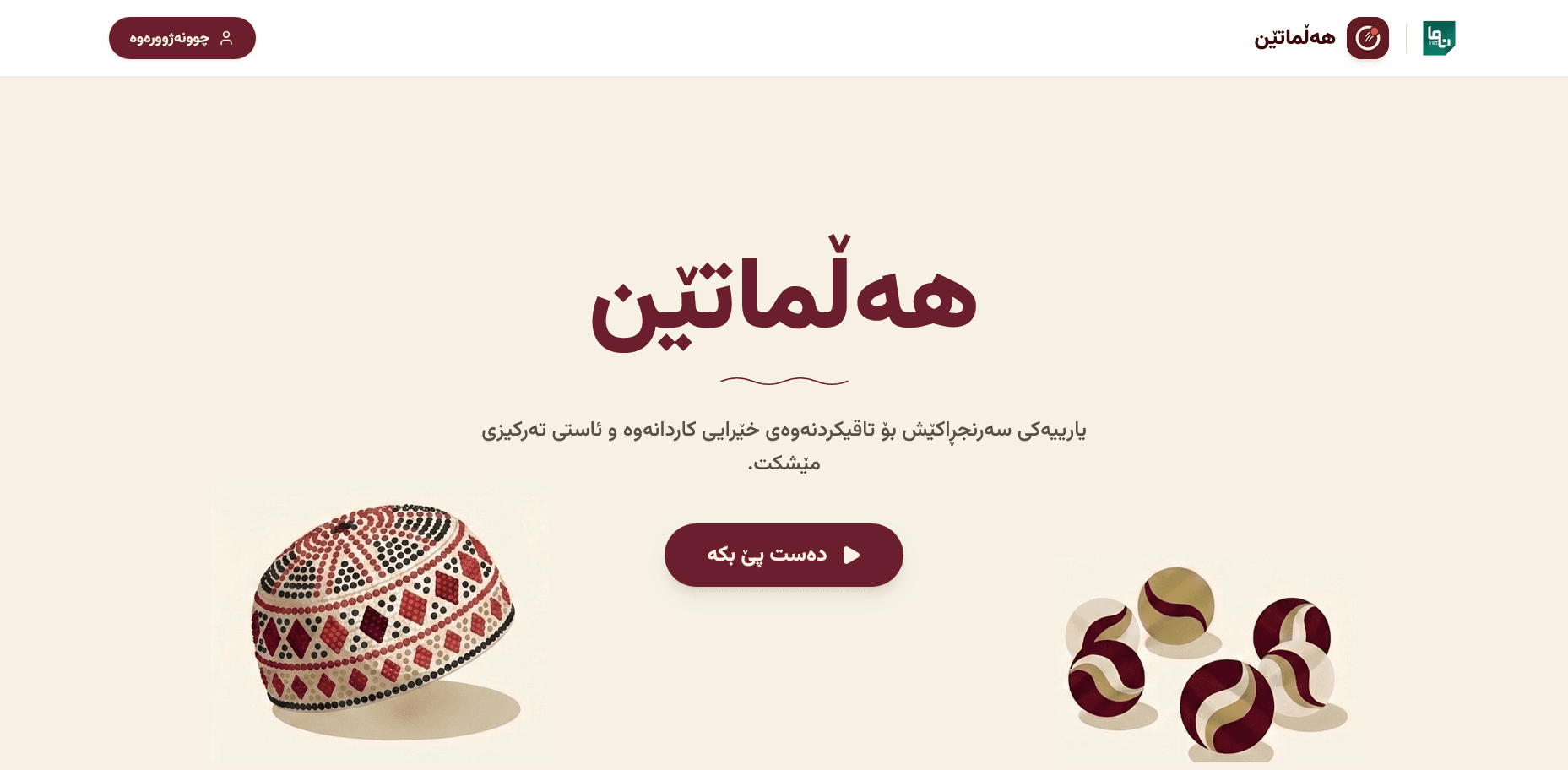
Halmaten
Culturally rooted Kurdish focus & cognitive game platform tested by 61 students
- Role
- Product Designer, Brand & Full-Stack Developer
- Status
- Live
- Year
- 2026
- Duration
- 3 days
- Stack
- Next.js
- Supabase
- Zustand
- Vercel
- Skills
- Kurdish Brand & Folkloric Game Design
- RTL UI/UX & Interactive Animations
- 3-Tier Difficulty & Math Scoring
- Z-Score Normalization & Leaderboard
- Links
- Live demo
Results
61
Students Ranked on Leaderboard
7
Progressive Focus Games
Problem
Most cognitive focus tests look like sterile foreign lab tasks that students quickly lose interest in. The challenge was to design an authentic Kurdish game brand ('Halmaten') rooted in familiar cultural games like 'Klaw Klawen', then run it as a supervised in-person student competition—which meant tightening the difficulty so scores didn't cluster near the maximum, and building accurate mathematical scoring to rank 61 students and pick a winner fairly.
What I built
- Crafted the warm cream-and-burgundy Kurdish brand identity, RTL typography, and custom visual assets featuring traditional Kurdish skullcaps ('Klaw') and marbles ('Halmat').
- Built 10 interactive cognitive games—including a digital 'Klaw Klawen' shell game tracking 5 skullcaps across 7 swaps over 6 progressive steps—managed on the client with Zustand.
- Engineered the Supabase backend with server-side score recomputation, accuracy percentage tracking, and z-score normalization powering the live Top-3 podium and general leaderboard ('ڕیزبەندی گشتی').
- Designed a name-plus-participant-code sign-in on Supabase Auth so students in the supervised session could enter without email or password, while keeping one student from signing in as another.
Gallery
Key decisions
Turning Kurdish Folklore ('Klaw Klawen') into Clinical Attention Games
Why
Instead of copying generic Western brain-training graphics, adapting 'Klaw Klawen' (finding the ring under shuffling Kurdish skullcaps across Easy/Medium/Hard swap speeds) made the cognitive test immediately relatable and fun for 61 Kurdish students.
Trade-off
Required custom cultural illustrations, RTL layout tuning, and careful calibration of swap counts and speeds across 6 steps per game.
Zustand State + Server-Side Score Recomputation
Why
Used Zustand to hold game and diagnostic state on the client, with persist as a resilience layer so a refresh doesn't wipe an in-progress run, while Supabase recomputes every score server-side from raw trial data so the podium and rankings can't be spoofed from the browser.
Trade-off
Every game had to return raw trial data in a shared result format, adding a validation layer on top of each game loop.
Technical notes
Composite Scoring, Accuracy Tracking & Z-Score Normalization
Combined per-game scores (accuracy percentages, reaction speed) with cohort-level z-score normalization so no single game's spread dominated the ranking, producing two-decimal composite ratings (e.g., 87.71, 87.14) on the leaderboard.
What I would do next
Halmaten was one of my favorite projects to build because I led the whole craft—from turning traditional Kurdish games like 'Klaw Klawen' into a cohesive digital brand and UI/UX, to tuning the difficulty math and watching 61 students compete on the live leaderboard.
Need something like this?
Available for full-time frontend/full-stack engineering positions, contract roles, and impactful civic tech initiatives.